
Chemistry Programs: What to Expect
What Do You Study in Chemistry?
Careers After Chemistry
Is Chemistry Hard to Study?
Top Certifications After Chemistry Graduation
Where to Study Chemistry
What is Chemistry?
Chemistry is often referred to as the “central science” because it connects physics, biology, environmental science, and medicine. It focuses on the composition, structure, and properties of matter, as well as the changes it undergoes during chemical reactions. A chemistry program typically encompasses a comprehensive study across various branches of chemistry, including organic, inorganic, analytical, physical, and biochemistry. Students in these programs are equipped with both theoretical knowledge and practical skills necessary for various scientific fields.
What Do You Study in Chemistry?
Core Subjects
- General Chemistry: Introduction to chemical principles, atomic structure, stoichiometry, and the periodic table. Often includes lab components where students learn techniques such as titration and spectroscopy.
- Organic Chemistry: The study of carbon-containing compounds, their structures, properties, reactions, and synthesis. Laboratory work focuses on synthesis and characterization of organic compounds.
- Inorganic Chemistry: Examines the properties and behaviors of inorganic compounds, including metals and minerals. Coursework may include coordination chemistry and bioinorganic topics.
- Physical Chemistry: Combines chemistry with physics, covering topics like thermodynamics, quantum mechanics, and reaction kinetics. Involves laboratory techniques to observe and manipulate chemical systems.
- Analytical Chemistry: Techniques for analyzing substances to identify chemical components and concentrations. May involve methods such as chromatography and mass spectrometry.
Elective Courses
- Biochemistry: Understanding the chemical processes in biological systems.
- Environmental Chemistry: The study of chemical phenomena in the environment; important for sustainability and pollution control.
- Materials Science: Investigating the properties of materials and their applications in various industries.
Labs, Workshops, and Internships
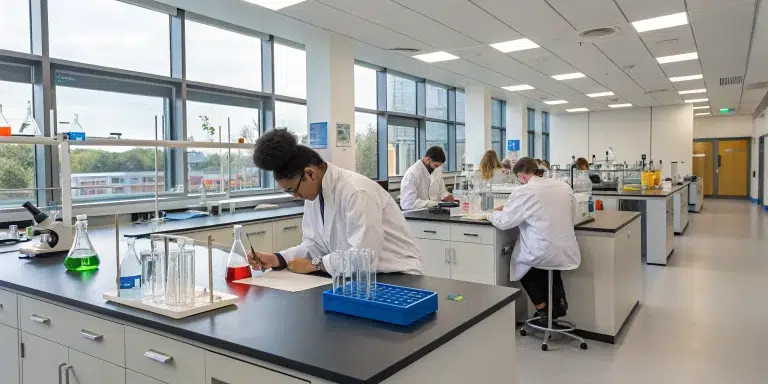
Laboratory work is a significant component of chemistry programs. Students are typically required to complete a set number of lab hours, often culminating in a research experience. Programs may also include workshops that provide practical applications of theoretical knowledge and internships that allow students to gain industry experience.
Careers After Chemistry
A degree in chemistry opens doors to a multitude of career paths across various industries. Here are some common career outcomes:
- Chemist
- Pharmaceutical Sales Representative
- Environmental Scientist
- Quality Control Analyst
- Forensic Scientist
- Research Scientist
- Chemistry Teacher or Professor
- Chemical Engineer
Salary Ranges
The salary for chemistry graduates can vary widely based on location, experience, and specific job roles. Below are average salary ranges in both USD and EUR:
- Chemist: Average Salary: $58,000 – $93,000 (USD) / €50,000 – €80,000 (EUR)
- Pharmaceutical Sales Representative: Average Salary: $70,000 – $120,000 (USD) / €60,000 – €100,000 (EUR)
- Environmental Scientist: Average Salary: $60,000 – $85,000 (USD) / €50,000 – €70,000 (EUR)
- Quality Control Analyst: Average Salary: $55,000 – $80,000 (USD) / €45,000 – €70,000 (EUR)
- Forensic Scientist: Average Salary: $50,000 – $80,000 (USD) / €40,000 – €70,000 (EUR)
Labor Market Trends
The demand for chemistry professionals is strong, particularly in sectors such as pharmaceuticals, environmental science, and materials science. Growth in renewable energy and biotechnology is also influencing the hiring of chemistry graduates.
Is Chemistry Hard to Study?
Studying chemistry can be challenging due to the complexity of the material and the required quantitative skills. Common challenges include:
- Abstract Concepts: Many principles in chemistry, like quantum mechanics and thermodynamics, can be complex and difficult for students to grasp initially.
- Mathematical Proficiency: Chemistry requires a solid understanding of mathematics to interpret data and perform calculations.
- Laboratory Skills: Practical laboratory work demands precision and attention to detail, which can be overwhelming for some students.
Required Skills
To succeed in a chemistry program, students should possess:
- Strong analytical skills
- A clear understanding of mathematical principles
- Excellent problem-solving abilities
- Laboratory technique proficiency
- A keen interest in science and research
Preparation Tips
- Strengthen Math Skills: Pre-calculus and calculus skills are essential.
- Engage with Laboratory Techniques: Familiarity with basic lab equipment and procedures can help ease the transition into lab courses.
- Study Groups: Collaborating with peers can be beneficial for understanding complex topics.
Top Certifications After Chemistry Graduation
After graduating with a degree in chemistry, certain certifications can enhance employability and demonstrate competency in the field. Key certifications include:
- Certified Chemist (CC): Offered by various professional organizations and widely recognized in the industry.
- Certificate in Chemical Engineering: For those looking to work in applied chemistry contexts.
- Accredited Professional Chemist (APC): A certification indicating a specific level of expertise and experience.
Where to Study Chemistry
Students interested in pursuing a chemistry program have various exemplary institutions to choose from. Here are some top private universities that offer robust chemistry programs:
- Medipol University (Link)
- Istinye University (Link)
- Bahcesehir University (BAU) (Link)
- Uskudar University (Link)
- Ozyegin University (Link)
These universities offer a combination of rigorous academic structures, quality faculty, and opportunities for hands-on experience.
Take the Next Step with Study in Turkiye
Whether you are a prospective student, a parent considering options for your child, or a university partner, it is crucial to make informed decisions regarding your academic journey in chemistry. For personalized help and more resources, feel free to reach out.

