
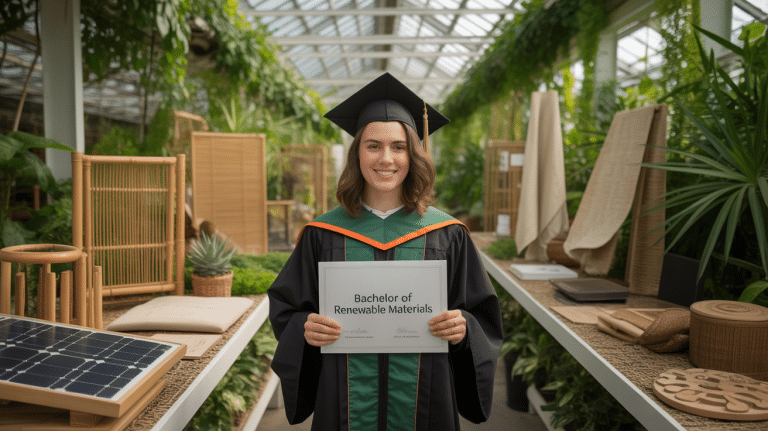
Bachelor of Renewable Materials: Program Overview
Quick Navigation
- What is the Bachelor of Renewable Materials?
- What Do You Study in the Bachelor of Renewable Materials?
- Careers After Graduation
- Is the Bachelor of Renewable Materials Hard to Study?
- Top Certifications After Bachelor of Renewable Materials Graduation
- Where to Study the Bachelor of Renewable Materials
What is the Bachelor of Renewable Materials?
The Bachelor of Renewable Materials is an interdisciplinary degree that combines elements of science, engineering, and management to address the challenges and opportunities within the renewable materials sector. Given the increasing pressure on industries to adopt sustainable practices, this program equips students with the essential knowledge and skills needed to innovate in the development and application of renewable materials.
Historically serving as critical components in construction, packaging, and manufacturing, materials derived from natural sources are essential for creating a sustainable future.
What Do You Study in the Bachelor of Renewable Materials?
Core Courses
- Materials Science Fundamentals: Understanding the physical and chemical properties of renewable materials like wood, paper, and biopolymers.
- Material Processing Techniques: Methods for transforming these materials into usable products, with a focus on sustainable practices.
- Sustainable Design Principles: Emphasizing environmentally friendly approaches in product design and development.
Elective Courses
- Paper Science and Technology: Covering the production processes of paper and its applications in various industries.
- Wood Science: Exploring the properties and uses of wood and wood-based products.
- Biopolymer Science: Understanding the chemical properties, production, and applications of biopolymers.
Laboratories and Workshops
- Laboratory Work: Students conduct experiments to test material properties and processing techniques.
- Workshops: Practical sessions where students can engage in real-world applications, enhancing their technical skills.
- Internships: Professional experience in a related industry, providing students with insights into workplace practices and challenges.
Careers After Graduation
Graduates of the Bachelor of Renewable Materials program have diverse career opportunities across various sectors. With an increased global focus on sustainability, the following are possible job titles and their corresponding industries:
- Packaging Technologist: Working on the development of sustainable packaging solutions.
- Product Development Scientist: Innovating new renewable products in manufacturing.
- Wood Products Manager: Overseeing operations in wood manufacturing and distribution.
- Biomaterials Scientist: Engaging in research and development for new biomaterials and their applications.
- Sustainability Consultant: Advising companies on incorporating sustainable practices into their operations.
- Quality Assurance Specialist: Ensuring that products meet quality and safety standards while being environmentally friendly.
Salary Expectations
According to various labor market trends, the average salaries for these roles vary based on location and experience:
- Packaging Technologist: $55,000–$75,000 USD / €50,000–€70,000 EUR
- Product Development Scientist: $60,000–$80,000 USD / €55,000–€75,000 EUR
- Sustainability Consultant: $70,000–$100,000 USD / €65,000–€90,000 EUR
Is the Bachelor of Renewable Materials Hard to Study?
Pursuing a degree in Renewable Materials can indeed present challenges. The program encompasses a variety of scientific disciplines, including chemistry, physics, and environmental science. Students may find the following aspects challenging:
- Complexity of Scientific Concepts: Mastering the intricate details of material properties and production processes can be daunting.
- Technical Skills Required: Laboratory work and hands-on projects demand a high level of technical skill and an understanding of equipment operation.
- Interdisciplinary Nature: The need to integrate knowledge from several fields can be overwhelming.
Required Skills and Preparation Tips
To succeed in this program, students should develop:
- Strong analytical and problem-solving skills.
- Proficiency in mathematics and basic sciences.
- Effective communication skills for teamwork and presentations.
Preparation Tips:
- Engage in relevant extracurricular activities, such as sustainability clubs or science fairs.
- Seek internships or volunteer opportunities related to materials science to gain practical experience.
- Utilize online courses or resources to strengthen foundational knowledge in chemistry and physics.
Top Certifications After Bachelor of Renewable Materials Graduation
While a bachelor’s degree opens many doors, certain certifications can enhance career prospects:
- Certified Packaging Professional (CPP): Recognizes expertise in packaging design and materials.
- Leadership in Energy and Environmental Design (LEED) Accreditation: A certification for professionals working on green building projects.
- Certified Six Sigma Green Belt: Useful for professionals involved in process improvement and quality management in production settings.
These certifications validate a graduate’s commitment to sustainability and industry standards, often leading to better job opportunities and advancement.
Where to Study the Bachelor of Renewable Materials
Here are some leading universities where students can pursue a Bachelor of Renewable Materials program:
These institutions offer robust programs focusing on renewable materials and sustainability, equipped with experienced faculty and advanced facilities.
Take the Next Step with Study in Turkiye
Ready to embark on a journey toward a promising career in renewable materials? Explore further with Study in Turkiye, your trusted authority for academic guidance.

