
Physics Programs: What to Expect
What is Physics?
What Do You Study in Physics?
Careers After Physics
Is Physics Hard to Study?
Top Certifications After Physics Graduation
Where to Study Physics
Conclusion
Introduction
Physics programs at the undergraduate level are designed for students who are curious about the natural world and eager to understand the fundamental laws governing matter, energy, and forces. These programs blend theoretical knowledge with practical experimentation, ensuring that graduates are equipped to tackle real-world problems. Ideal for students interested in pursuing careers in science, engineering, or technology, physics programs offer diverse educational pathways tailored to various interests.
What is Physics?
Physics is the branch of science concerned with the nature and properties of matter and energy. It encompasses a broad range of topics, from the very small—like subatomic particles—to the vast scales of astrophysics. Students of physics learn to apply mathematical models to understand complex systems, examining how they interact and evolve over time. The field of physics bridges numerous scientific disciplines, providing a foundation for advancements in engineering, technology, and medicine.
What Do You Study in Physics?
Core Subjects
In a physics program, students typically engage with a core set of subjects designed to build foundational knowledge. Here are some of the core areas of study:
- Classical Mechanics: This course focuses on the laws governing motion and forces, providing a basis for understanding the mechanics of objects and particles.
- Electromagnetism: Students explore electric charges, magnetic fields, and the interaction between them.
- Thermodynamics: This subject covers the laws of heat and energy transfer, crucial for understanding physical systems.
- Quantum Mechanics: A deeper dive into the behavior of matter on a subatomic level, this course introduces students to probabilistic models and the quantization of energy.
- Relativity: This subject examines the theories of special and general relativity, altering perceptions of space, time, and gravity.
Elective Courses
Depending on their career interests, students may select from a variety of elective courses, such as:
- Astrophysics: Explore the properties of celestial bodies and the universe.
- Biophysics: Investigate the biological effects of physical principles.
- Condensed Matter Physics: Understand the properties of solid and liquid states of matter.
- Plasma Physics: Study the behavior of ionized gases.
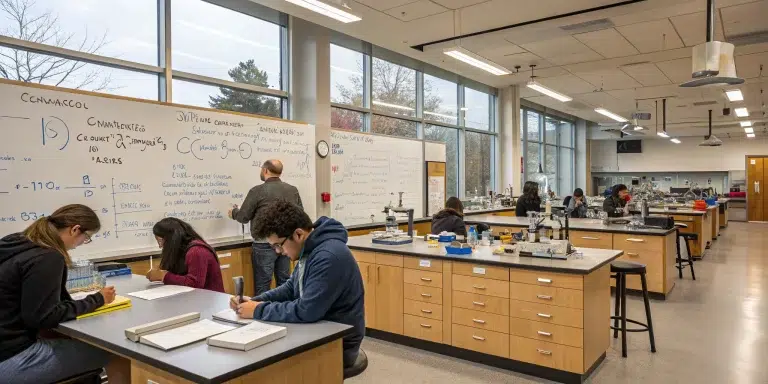
Labs, Workshops, and Internships
Practical experience is a vital component of physics education. Most programs incorporate:
- Laboratory Work: Hands-on experiments complement theoretical learning, allowing students to observe physical phenomena directly and hone their experimental skills.
- Research Opportunities: Many programs encourage participation in faculty-led research projects, enabling students to engage with real-world scientific inquiries.
- Internships: Students benefit from internships in various sectors, including aerospace, renewable energy, and research institutions, facilitating career readiness.
Careers After Physics
Graduates of physics programs enter a diverse array of fields, leveraging their analytical and problem-solving skills. Some potential career paths include:
- Research Scientist
- Data Analyst
- Software Developer
- Mechanical Engineer
- Medical Physicist
- High School Physics Teacher
- Aerospace Engineer
- Quantitative Analyst
Industry Sectors
Physics graduates can find employment in numerous sectors, including:
- Academia
- Government Research Laboratories
- Aerospace and Defense
- Energy and Utilities
- Telecommunications
- Healthcare
- Technology and Software Development
Average Salaries
The earning potential for physics graduates varies by position, industry, and location. Below are average global salary ranges:
- Research Scientist: $85,000 – $115,000 USD, €75,000 – €100,000 EUR
- Data Analyst: $65,000 – $95,000 USD, €55,000 – €80,000 EUR
- Software Developer: $75,000 – $120,000 USD, €65,000 – €110,000 EUR
- Mechanical Engineer: $70,000 – $100,000 USD, €60,000 – €90,000 EUR
- Medical Physicist: $100,000 – $130,000 USD, €90,000 – €115,000 EUR
Is Physics Hard to Study?
The study of physics presents its challenges, requiring dedication and a strong mathematical foundation. Students often find certain areas particularly demanding, such as:
- Complex Mathematics: Proficiency in advanced mathematics, including calculus and differential equations, is essential.
- Conceptual Understanding: Many physical concepts, particularly in quantum mechanics and relativity, can be counterintuitive and require deep contemplation.
- Problem-Solving: Physics often involves complex problem-solving, requiring analytical thinking and creativity.
Required Skills
To succeed in physics, students should develop:
- Strong analytical skills
- Proficiency in mathematics
- Critical thinking abilities
- Resilience and persistence
Preparation Tips
Students preparing for a physics program can benefit from:
- Completing advanced mathematics courses in high school
- Engaging in science clubs or competitions
- Seeking internships or volunteer experiences in scientific settings
- Developing strong problem-solving and critical thinking skills
Top Certifications After Physics Graduation
While many physics-related careers do not require formal certifications, certain specialized areas may require additional qualifications:
- Certified Medical Physicist (CMP): For those pursuing work in healthcare physics, often requiring passing the American Board of Radiology examination.
- Engineer-in-Training (EIT): For engineering physics graduates seeking licensure as Professional Engineers.
- Data Science Certificates: Considered beneficial for those entering data analysis roles.
Where to Study Physics
If you’re interested in pursuing a degree in physics, several top universities in Turkiye offer robust programs:
Conclusion
Studying physics opens the door to a vast array of career opportunities in academics, industry, and research. By understanding the core principles and engaging in hands-on experience through labs and internships, students are well-prepared for the challenges of the professional world. If you’re considering a degree in physics, reach out to Study in Turkiye for personalized guidance and resources to help you navigate your academic journey effectively.
Take the Next Step with Study in Turkiye
Explore further opportunities to advance your education in physics and related fields.

