
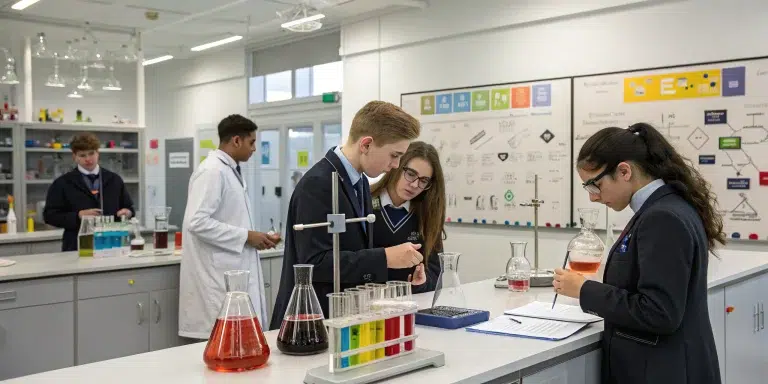
Overview of Chemistry Programs
What is Chemistry?
Chemistry is the branch of science that deals with the composition, structure, properties, and changes of matter. Often referred to as the “central science,” chemistry connects physics with other natural sciences such as biology and geology. A Chemistry program cultivates analytical skills and practical laboratory knowledge crucial for tackling complex scientific challenges.
What Do You Study in Chemistry?
A Chemistry curriculum focuses heavily on both theoretical and practical knowledge. Students can expect a balanced educational experience that includes foundational courses, advanced topics, and laboratory work.
Core Subjects
-
General Chemistry
- Topics Covered: Basic chemical principles, stoichiometry, atomic structure, and thermodynamics.
- Laboratory Component: Students engage in hands-on experiments to apply learned concepts.
-
Organic Chemistry
- Topics Covered: The structure, properties, and reactions of carbon-containing compounds.
- Laboratory Component: Analysis and synthesis of organic compounds, providing practical experience.
-
Analytical Chemistry
- Topics Covered: Techniques for analyzing chemical compounds, including spectroscopy and chromatography.
- Laboratory Component: Focus on quantitative and qualitative analyses in various mixtures.
-
Physical Chemistry
- Topics Covered: The study of how matter behaves on a molecular and atomic level, including thermodynamics.
- Laboratory Component: Experiments focusing on chemical kinetics and equilibrium.
-
Inorganic Chemistry
- Topics Covered: The study of inorganic compounds and materials, including metals and minerals.
- Laboratory Component: Preparation and characterization of inorganic compounds.
Elective Courses
Students can often choose from a range of electives, depending on their interests and career goals. Some common electives may include:
- Environmental Chemistry
- Medicinal Chemistry
- Polymer Chemistry
- Biochemistry
Labs, Workshops, and Internships
Most Chemistry programs emphasize laboratory work, with courses incorporating lab components to reinforce theoretical learning. Additionally, many institutions offer:
- Research Opportunities: Students may participate in faculty-led research projects.
- Internships: Internships in industries such as pharmaceuticals, environmental agencies, and educational institutions can provide practical experience and enhance employability.
Careers After Chemistry
Graduates with a degree in Chemistry can pursue a variety of career paths in diverse sectors. Here’s a breakdown of potential job titles and industries:
Potential Job Titles
- Industrial Chemist
- Research Scientist
- Environmental Chemist
- Quality Control Analyst
- Forensic Scientist
- Science Educator
- Regulatory Affairs Specialist
Industries and Sectors
- Pharmaceuticals
- Environmental Science and Sustainability
- Food and Beverage
- Education
- Government and Regulatory Agencies
- Chemical Manufacturing
Average Salaries
Salaries can vary widely based on location, experience, and specific job roles. Here are some average salary ranges in USD and EUR:
- Industrial Chemist: $60,000 – $100,000 (EUR 55,000 – EUR 90,000)
- Research Scientist: $65,000 – $95,000 (EUR 60,000 – EUR 85,000)
- Environmental Chemist: $55,000 – $85,000 (EUR 50,000 – EUR 75,000)
- Quality Control Analyst: $55,000 – $80,000 (EUR 50,000 – EUR 70,000)
- Forensic Scientist: $55,000 – $75,000 (EUR 50,000 – EUR 65,000)
Is Chemistry Hard to Study?
Chemistry can be challenging for various reasons, including the need for strong analytical skills, mathematical aptitude, and the ability to grasp abstract concepts. Common challenges faced by students include:
- Mathematical Proficiency: Many chemistry topics require a solid understanding of algebra and calculus.
- Laboratory Skills: Developing hands-on skills demands practice and attention to detail.
- Memorization: A significant amount of information, including chemical reactions and properties, requires memorization.
Required Skills
- Analytical Thinking: Ability to assess complex problems and derive solutions logically.
- Mathematical Skills: Competency in calculations related to chemical equations and data analysis.
- Attention to Detail: Precision is vital in both lab experiments and theoretical calculations.
- Communication Skills: Essential for effectively conveying scientific concepts and data.
Preparation Tips
- Develop Strong Foundations: Focus on high school chemistry and math courses to prepare for university-level studies.
- Practice Laboratory Techniques: Engage in laboratory activities to enhance practical skills.
- Utilize Study Groups: Collaboration with peers can deepen understanding of complex topics.
Top Certifications After Chemistry Graduation
After graduating with a degree in Chemistry, students may need to obtain specific certifications to enhance their employability. Some essential certifications might include:
- Certified Chemist (CC): Offered by various professional organizations, verifying competency in chemistry.
- Laboratory Safety Certification: Ensures knowledge of safe laboratory practices and regulations.
- Quality Assurance Certification: Useful for those pursuing careers in industries focusing on quality control.
These certifications may enhance job prospects and professional credibility in various fields.
Where to Study Chemistry
For students interested in pursuing a Chemistry program abroad, consider the following top universities that offer excellent Chemistry degrees:
- Medipol University, Istanbul
- Istinye University, Istanbul
- Bahcesehir University, Istanbul
- Aydin University, Istanbul
These universities are known for their rigorous Chemistry programs and strong industry connections, providing students with opportunities for internships and research.
Conclusion
Chemistry programs equip students with valuable skills and a solid foundation in the principles of matter and chemical reactions. With a diverse range of career opportunities available upon graduation, pursuing a degree in Chemistry can lead to fulfilling and rewarding professions in various sectors. For personalized assistance in finding the right academic program that meets your needs, reach out to SIT Search today.
Take the Next Step with Study in Turkiye
Explore your options for studying Chemistry in Turkiye and take the next step towards a rewarding academic and career path.

