
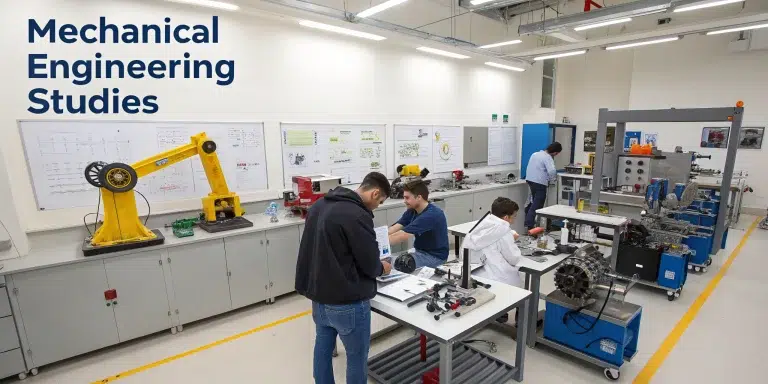
Overview of Mechanical Engineering Studies
What is Mechanical Engineering?
Mechanical Engineering is a broad and versatile discipline that focuses on the design, development, and maintenance of machines and mechanical systems aimed at solving real-world problems. This field combines advanced mathematics, core engineering principles, and hands-on laboratory experience to prepare students for diverse challenges in modern industry.
Mechanical Engineering is ideal for those who are passionate about technology, enjoy problem-solving, and are interested in creating innovative solutions across various sectors.
What Do You Study in Mechanical Engineering?
Core Subjects and Elective Courses
Core Subjects
- Mathematics
- Integral and Differential Calculus
- Linear Algebra
- Differential Equations
- Physics
- Mechanics
- Thermodynamics
- Fluid Dynamics
- Core Mechanical Engineering Courses
- Machine Design
- Materials Science
- Dynamics and Kinematics
- Computer-Aided Design (CAD)
- Solid Modeling and Simulation
- Finite Element Analysis
Elective Courses
- Specialized Engineering Topics
- Robotics Engineering
- Mechatronics
- Thermal Systems
- Emerging Technologies
- Additive Manufacturing
- Nanotechnology
- Business and Management for Engineers
- Engineering Management
- Project Management
Labs, Workshops, and Internships
Students will also participate in hands-on labs and workshops where they can apply what they have learned in class. Typical hands-on experiences include:
- Capstone Projects: Real-world engineering problems solved in teams, involving design, analysis, and fabrication of projects.
- Laboratory Work: Practical experiments in thermodynamics, fluid mechanics, and materials testing.
- Internships: Opportunities with companies in relevant industries to gain practical skills and workplace experience.
Careers After Mechanical Engineering
A degree in Mechanical Engineering opens up a wealth of career opportunities across various sectors. Graduates are equipped with the skills needed to innovate and improve systems and processes.
- Mechanical Engineer
- Design Engineer
- Project Engineer
- Manufacturing Engineer
- Aerospace Engineer
- Robotics Engineer
- Energy Systems Engineer
- Quality Control Engineer
- Thermal Engineer
Average Salaries Globally
Salary ranges for Mechanical Engineers can vary based on experience, industry, and geography. Here are some average salary estimates globally:
- Entry-Level Mechanical Engineer: USD $60,000 – $75,000 / EUR €50,000 – €63,000
- Mid-Career Mechanical Engineer: USD $75,000 – $95,000 / EUR €63,000 – €80,000
- Senior Mechanical Engineer: USD $95,000 – $130,000 / EUR €80,000 – €110,000
Is Mechanical Engineering Hard to Study?
Mechanical Engineering is known for its rigorous curriculum, which can be challenging but rewarding. Common challenges include:
- High Workload: Balancing theoretical coursework with labs and projects can be demanding.
- Advanced Mathematics: Students must be comfortable with calculus, differential equations, and numerical methods.
- Problem-Solving: Courses often require innovative thinking and practical application of concepts, which can be daunting.
Required Skills
To succeed in Mechanical Engineering, students should develop:
- Strong analytical and mathematical skills
- Critical thinking and problem-solving abilities
- Effective communication and teamwork skills
- Time management for balancing coursework and projects
Preparation Tips
- Strengthen Mathematical Foundations: A solid grasp of mathematics is essential. Consider taking additional mathematics courses if needed.
- Engage in Hands-On Projects: Practical experience is invaluable. Participate in engineering clubs or robotics competitions.
- Utilize Resources: Don’t hesitate to ask for help from professors, tutors, or peers when facing challenging topics.
Top Certifications After Mechanical Engineering Graduation
While a degree is foundational, certain certifications can notably enhance career prospects and demonstrate expertise in specialized areas:
- Certified Engineering Technician (CET)
- Professional Engineer (PE) Licensure
- Project Management Professional (PMP)
- Six Sigma Certification
- Certified Manufacturing Engineer (CMfgE)
Where to Study Mechanical Engineering
Several universities offer reputable Mechanical Engineering programs, particularly if you are considering studying abroad. Here are some top private universities that provide excellent mechanical engineering programs:
Conclusion
Embarking on a Mechanical Engineering program presents a pathway filled with opportunities for innovation and challenges. Graduates emerge ready to tackle pressing technological issues and contribute to various industries poised for growth and transformation.
Take the Next Step with Study in Turkiye
For personalized assistance in finding the right academic program suited to your interests, reach out to SIT Search today! Your future in Mechanical Engineering awaits!

