
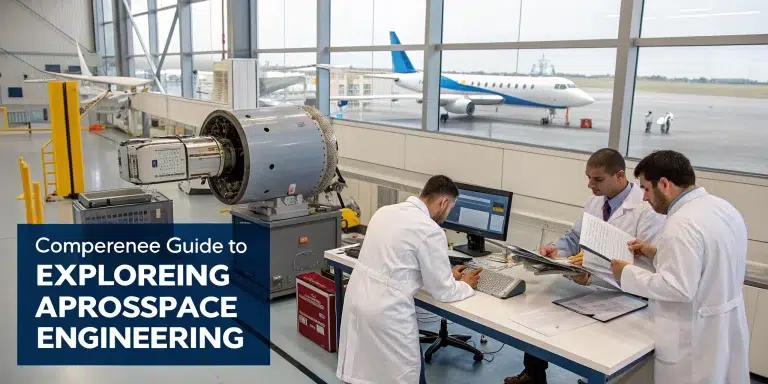
Exploring Aerospace Engineering: A Comprehensive Guide
What is Aerospace Engineering?
Aerospace Engineering is the branch of engineering focused on the design, development, testing, and production of aircraft, spacecraft, and related systems and equipment. It encompasses two main fields: aeronautical engineering, which deals with aircraft that operate within Earth’s atmosphere, and astronautical engineering, which focuses on spacecraft that operate outside the atmosphere. Through the study of Aerospace Engineering, students gain the skills necessary to innovate and advance technology in transportation, defense, and space exploration.
What Do You Study in Aerospace Engineering?
Aerospace Engineering programs offer a comprehensive curriculum that prepares students for diverse challenges in the aerospace sector. Students typically engage in both theoretical coursework and practical applications, including labs, workshops, and internships.
Core Subjects
- Aerodynamics: Study of fluid dynamics and the behavior of air as it interacts with moving objects.
- Propulsion Systems: Examination of engines and the principles of thrust generation.
- Materials and Structures: Focus on the properties of materials and their behavior under different stress and thermal conditions.
- Flight Mechanics: Understanding aircraft performance, stability, and control.
- Orbital Mechanics: Analyzing the motion of objects in space under the influence of gravitational forces.
- Control Systems: Design and implementation of control systems for stability and navigation.
Elective Courses
- Unmanned Aerial Vehicles (UAVs)
- Advanced Propulsion Techniques
- Astrodynamics and Spacecraft Navigation
- Environmental Impact of Aerospace Systems
Labs, Workshops, and Internships
Practical experience is a key part of Aerospace Engineering programs. This often includes:
- Laboratories: Hands-on experiments analyzing aerodynamic properties and materials.
- Workshops: Collaborative projects focusing on design and simulation tools, such as CAD software.
- Internships: Opportunities with aerospace companies and government organizations, providing real-world experience and networking.
Careers After Aerospace Engineering
Graduates of Aerospace Engineering possess the qualifications to pursue a variety of roles across multiple sectors, including aerospace, automotive, defense, and academia.
Sample Job Titles
- Aerospace Engineer
- Propulsion Engineer
- Flight Test Engineer
- Avionics Engineer
- Structural Engineer
- Systems Engineer
- Research and Development Engineer
Industries and Sectors
- Commercial Aviation
- Defense and Military
- Space Exploration Agencies (e.g., NASA, ESA)
- Research Institutions
- Automotive Sector
Average Salaries
In the United States, the average salary for an Aerospace Engineer ranges from $70,000 to $120,000 annually, depending on experience and specialization. In the European Union, aerospace engineers can expect salaries from €50,000 to €90,000 yearly, influenced by location and industry.
Is Aerospace Engineering Hard to Study?
Common Challenges
- Complex Mathematical Concepts
- Physics Applications
- Time Management
Required Skills
- Strong analytical thinking and problem-solving abilities
- Proficiency in mathematics and physics
- Effective communication skills for teamwork and presentation
- Attention to detail and precision in design and testing
Preparation Tips
- Engage with foundational STEM courses to prepare for the rigorous mathematics and science aspects of the program.
- Participate in robotics clubs or internships related to engineering.
- Utilize resources such as tutoring centers and study groups during university.
Top Certifications After Aerospace Engineering Graduation
After completing an Aerospace Engineering degree, several certifications may enhance a graduate’s employability and career advancement. These include:
- Certified Aerospace Technician (CAT)
- Engineer in Training (EIT)
- Project Management Professional (PMP)
Essential Licenses and Exams
In various countries, graduates may need to pass specific exams or acquire licenses to work professionally:
- Fundamentals of Engineering (FE) Exam
- Country-specific regulation exams as required by local engineering boards.
Where to Study Aerospace Engineering
For students interested in pursuing a degree in Aerospace Engineering, several respected institutions offer robust programs:
Take the Next Step with Study in Turkiye
Explore your options and take the first step towards a rewarding career in Aerospace Engineering.

