
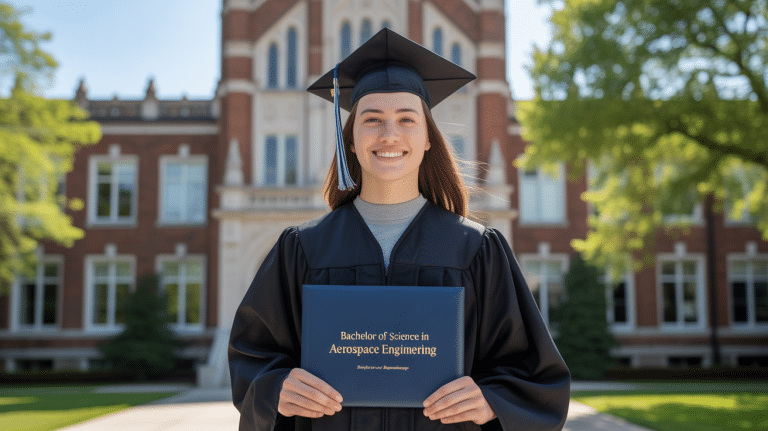
Bachelor of Science in Aerospace Engineering
Overview of the Program
The Bachelor of Science in Aerospace Engineering is an undergraduate program meticulously designed to equip students with the essential skills required for the aerospace industry. It offers a structured curriculum focused on both fundamental scientific principles and specialized knowledge critical to the design, production, and operation of aircraft and spacecraft. This program is ideal for individuals passionate about technology, physics, and engineering, aiming to tackle challenges in aircraft design, space exploration, and related sectors.
What is Aerospace Engineering?
Aerospace Engineering is a branch of engineering that deals with the design, development, testing, and production of aircraft, spacecraft, and their various components. It merges advanced principles of engineering with innovation in technology, leading to new heights in aviation and space exploration. Aerospace engineers are involved in various aspects of aerospace projects, including aerodynamics, materials science, structural analysis, propulsion, and systems integration.
The degree program prepares students for careers in diverse fields such as commercial aviation, defense, aerospace manufacturing, and air transportation. It emphasizes both theoretical understanding and practical application through hands-on experience in labs and workshops.
What Do You Study in Aerospace Engineering?
Year 1: Foundations
- Core Courses:
- Mathematics: Calculus and Linear Algebra
- Basic Sciences: Physics and Chemistry
- Communication Skills: Technical Writing and Presentation
- Introduction to Aerospace Engineering: Overview of the aerospace field and career paths
Year 2: Engineering Sciences
- Further Development:
- Advanced Mathematics: Differential Equations and Numerical Methods
- Engineering Science Courses: Statics, Dynamics, and Thermodynamics
- Computer Programming: Introduction to coding, particularly for engineering applications
Year 3: Major Subdomains
- Specialized Courses Include:
- Fluid Mechanics: Study of the behavior of fluids in motion.
- Aerodynamics: Understanding the forces and resulting motion of air interacting with solid bodies.
- Propulsion: Fundamentals of engine design and performance characteristics.
- Structures: Analysis of stressed materials, load factors, and airframe design.
- Flight Dynamics: Dynamics of flight and control systems – integrating various forces acting on an aircraft.
Year 4: Integration and Design
- Capstone Projects: Students participate in comprehensive design projects that require integrating knowledge from various subdomains, focusing on analytical, experimental, and design perspectives, allowing specialization in either atmospheric or space flight.
Electives and Specialization
Students can enhance their education by selecting elective courses in more specialized fields such as:
- Advanced Propulsion Systems
- Aerospace Systems Integration
- Flight Control Engineering
- Structural Analysis and Design
Labs, Workshops, and Internships
Practical experience is a vital component of the Aerospace Engineering program. Students frequently engage in:
- Labs: Hands-on experiments related to aerodynamics, propulsion, and materials testing.
- Workshops: Opportunities to work with industry-standard software for design and simulation (e.g., CATIA, ANSYS).
- Internships: Exposure to real-world applications and work environments in aerospace companies, enhancing employability and industry understanding.
Careers After Aerospace Engineering
Graduates of a Bachelor of Science in Aerospace Engineering are well-equipped to enter a lucrative job market, prepared for various roles such as:
- Aerospace Engineer: Focused on design, research, and development in the aerospace sector.
- Systems Engineer: Responsible for system design and integration for aircraft and spacecraft.
- Research Engineer: Conducting research and development in government or private aerospace labs.
- Quality Assurance Engineer: Ensuring products meet required safety and quality standards.
- Technical Consultant: Providing expertise on aerospace technology and systems engineering.
Sample Job Titles and Industries
- Aerospace Engineer
- Industry: Aircraft manufacturing, Defense contractors, Space agencies
- Average Salary: $104,000 USD / €88,000 EUR
- Systems Engineer
- Industry: Aerospace firms, Government entities
- Average Salary: $83,000 USD / €70,000 EUR
- Research Engineer
- Industry: National Laboratories, Universities
- Average Salary: $95,000 USD / €80,000 EUR
- Quality Assurance Engineer
- Industry: Manufacturing, Aviation services
- Average Salary: $75,000 USD / €63,000 EUR
- Technical Consultant
- Industry: Consulting agencies, Engineering firms
- Average Salary: $91,000 USD / €76,000 EUR
Is Aerospace Engineering Hard to Study?
Aerospace Engineering is considered a challenging field due to the complexity of the subjects and the depth of understanding required. Students often confront difficulties in:
- Advanced Mathematics: Courses can be demanding and require strong analytical skills.
- Physics Principles: Understanding the intricate laws governing flight and propulsion involves rigorous study.
- Time Management: Balancing a heavy workload of theory and practical applications can be tough.
Common Challenges and Required Skills
- Strong foundation in mathematics and physics.
- Problem-solving and critical-thinking abilities.
- Proficiency in software tools used for simulations and modeling.
Preparation Tips
- Review foundational materials in mathematics and physics before enrolling.
- Engage in study groups for collaborative problem-solving.
- Seek internships or projects related to aerospace to gain practical exposure.
Top Certifications After Aerospace Engineering Graduation
After graduation, students may consider pursuing the following certifications to enhance their career prospects:
- Professional Engineer (PE): Licensing required for many engineering roles in the U.S. and some other countries, providing credibility and opportunities in aerospace engineering.
- Project Management Professional (PMP): Valuable for engineers intending to move into project management roles within aerospace projects.
- Certified Aerospace Technician (CAT): Recognized certification for technicians involved in the maintenance and repair of aerospace systems.
Where to Study Aerospace Engineering
For students interested in pursuing a Bachelor of Science in Aerospace Engineering, here are some notable institutions:
Read More:
For personalized guidance in exploring these programs, please reach out to Study in Turkiye. We are here to help you make informed decisions about your academic future in aerospace engineering.
Take the Next Step with Study in Turkiye
Explore further and consider pursuing your studies in Aerospace Engineering.

