
Aerospace Engineering Studies: Building Your Future
Quick Navigation
What is Aerospace Engineering?
Aerospace Engineering combines elements from various engineering fields to form a specialized discipline focused on aircraft and spacecraft. It encompasses the study of aerodynamics, structural analysis, propulsion systems, and control systems, with an ultimate goal of producing innovations that enhance flight and space exploration capabilities. This field is integral to both commercial aviation and space exploration, offering a wide array of opportunities for graduates.
The two primary branches of Aerospace Engineering include:
- Aeronautical Engineering: Concentrating on vehicles that operate within the Earth’s atmosphere.
- Astronautical Engineering: Focusing on vehicles that travel beyond the Earth’s atmosphere.
What Do You Study in Aerospace Engineering?
Aerospace Engineering programs typically span four years, leading to a Bachelor of Science degree. The curriculum is meticulously crafted to equip students with both theoretical knowledge and practical skills necessary for success in the aerospace sector.
Core Subjects
- Fundamental Engineering Principles:
- Mechanics
- Thermodynamics
- Materials Science
- Solid Mechanics
- Fluid Mechanics
- Heat Transfer
- Specialized Aerospace Topics:
- Aerospace Structures
- Aerodynamics
- Flight Mechanics
- Propulsion
- Control Systems
- Aerospace Design
Electives and Labs
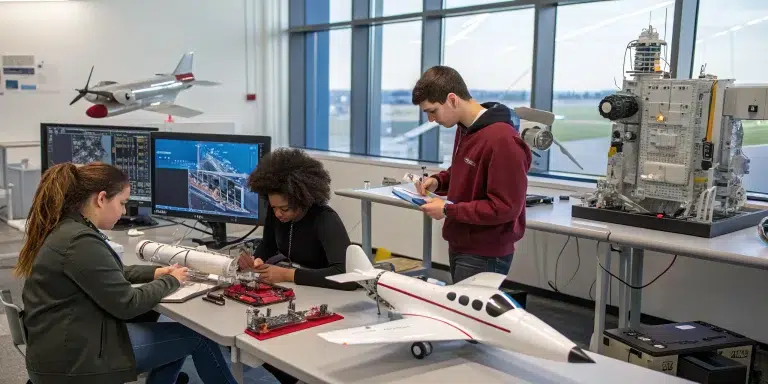
In addition to core subjects, students may have the option to pursue elective courses that align with their interests, such as robotics, materials engineering, or computational fluid dynamics. Practical applications are emphasized through:
- Hands-on Laboratory Projects
- Capstone Design Experiences
- Internships
Careers After Aerospace Engineering
Graduates of Aerospace Engineering programs are well-prepared for a variety of careers within the aerospace and defense industries as well as related sectors. Some of the key career pathways include:
- Aircraft Engineer: Responsible for the design, development, and testing of aircraft.
- Spacecraft Engineer: Focuses on systems and structures involved in space exploration.
- Aerospace Technician: Works under engineers to assist in the building and maintenance of aircraft and spacecraft.
- Propulsion Engineer: Specializes in the development and testing of engines for aircraft and rockets.
- Systems Engineer: Oversees the complex systems and technology involved in aerospace projects.
- Research Scientist: Engaged in theoretical research to advance aerospace technologies.
Salary Overview
Salaries for Aerospace Engineering roles can vary widely by location, experience, and specialization. Here are average salary ranges globally:
- Aerospace Engineer: Average Salary: $84,000 – $130,000 USD (€70,000 – €110,000)
- Propulsion Engineer: Average Salary: $85,000 – $125,000 USD (€72,000 – €105,000)
- Systems Engineer: Average Salary: $75,000 – $120,000 USD (€63,000 – €100,000)
- Aerospace Technician: Average Salary: $50,000 – $75,000 USD (€42,000 – €63,000)
Is Aerospace Engineering Hard to Study?
Aerospace Engineering is commonly viewed as a challenging field of study due to the complex and multidisciplinary nature of the subject matter. Here are some common challenges and required skills:
Common Challenges
- Mathematics and Physics Demand: A strong foundation in calculus, differential equations, and physics is essential.
- High Workload: The program typically involves rigorous coursework, projects, and laboratory work that can be time-consuming.
- Conceptual Understanding: Many principles in aerodynamics and mechanics can be abstract and require critical thinking to grasp fully.
Required Skills
- Analytical Thinking: Ability to analyze data and systems to solve complex engineering problems.
- Team Collaboration: Many aerospace projects require teamwork and collaboration among diverse professionals.
- Attention to Detail: Precision is critical in design and testing, where small errors can lead to significant issues.
Preparation Tips
- Strengthen Math and Science Foundations.
- Pursue Practical Experience through internships.
- Utilize Academic Resources for support.
Top Certifications After Aerospace Engineering Graduation
While a degree in Aerospace Engineering opens many career doors, obtaining additional certifications can enhance job prospects and professional credibility. Here are some recognized certifications:
- Engineer-in-Training (EIT): The first step towards becoming a licensed Professional Engineer (PE).
- Project Management Professional (PMP): Valuable for engineers overseeing engineering projects.
- Certified Aerospace Technician (CAT): Specializes in aircraft maintenance and operations.
Where to Study Aerospace Engineering
Pursuing Aerospace Engineering from reputable institutions is crucial for obtaining a quality education. Here are some top universities where students can study Aerospace Engineering:
Take the Next Step with Study in Turkiye
Embarking on a journey in Aerospace Engineering can be exciting and fulfilling. Explore your options to find the best program that aligns with your career goals today!

