
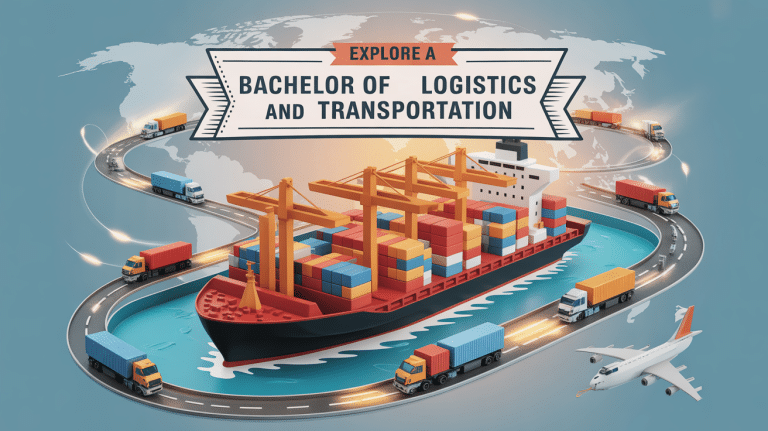
Overview of the Bachelor of Logistics and Transportation
What is Logistics and Transportation?
Logistics and Transportation is a field that focuses on the planning, implementation, and control of the efficient movement and storage of goods, services, and related information from the point of origin to the point of consumption. The program emphasizes the importance of providing timely delivery while minimizing costs and maximizing customer satisfaction. Students learn to navigate complex logistical challenges, applying innovative solutions to real-world problems within the supply chain.
The curriculum is designed to cover various transportation modes—such as air, land, and sea—as well as the economic, regulatory, and legal frameworks that govern the industry. Graduates of this program are prepared to engage in strategic decision-making that impacts business operations globally.
What Do You Study in Logistics and Transportation?
Core Areas of Study:
Principles and Policies
In this foundational course, students explore the basic concepts, policies, and current trends within the transportation sector, including the intricacies of air, maritime, and ground transportation systems.
Supply Chain & Logistics Management
Students delve into the complete supply chain process—from sourcing raw materials to delivering finished products. Key topics include procurement strategies, asset management, logistics information systems, and distribution networks.
Operations & Planning
This course focuses on operational planning and the vital aspects of inventory management. Students learn about terminal operations, transportation planning, and the efficient use of equipment necessary for successful logistics management.
Transportation Modes & Economics
This segment examines various transportation modes, analyzing their strengths and weaknesses. Students learn about transportation economics and policies, evaluating how economic factors influence transportation decisions.
Regulatory & Legal Frameworks
In this course, students gain insights into the political, regulatory, and legal challenges that affect transportation strategies in domestic and international contexts.
Global and Cultural Context
Students study the global nature of logistics, focusing on the movement of freight and passengers across borders, along with the influence of cultural differences on business practices.
Real-world Application
Practical experience is reinforced through internships, field tours, and guest lectures from industry professionals, allowing students to apply theoretical knowledge in real-world scenarios.
Sample Program Structure:
| Component | Credits/Details |
|---|---|
| General Education | 30 semester hours |
| Major Requirements | 30 semester hours |
| Concentration or Electives | 15–42 semester hours |
| Final Program Requirement/Capstone | 3 semester hours |
| Total | 120 semester hours |
Careers After Logistics and Transportation
Graduates with a Bachelor in Logistics and Transportation can pursue diverse career opportunities across various sectors, including manufacturing, distribution, retail, and government. Common job titles include:
- Logistics Coordinator/Manager
- Transportation Manager
- Supply Chain Analyst
- Inventory Manager
- Operations Planner
- Distribution Manager
- Asset Management Specialist
- Import/Export Coordinator
- Freight Operations Supervisor
Salary Expectations:
The earning potential for logistics and transportation professionals varies based on factors such as experience, job role, and geographical location. Here are some average salary ranges in both USD and EUR globally:
- Logistics Coordinator/Manager: $50,000 – $80,000 (EUR 45,000 – 70,000)
- Transportation Manager: $60,000 – $90,000 (EUR 55,000 – 80,000)
- Supply Chain Analyst: $55,000 – $85,000 (EUR 50,000 – 75,000)
- Inventory Manager: $50,000 – $79,000 (EUR 45,000 – 70,000)
- Operations Planner: $60,000 – $100,000 (EUR 55,000 – 90,000)
- Distribution Manager: $65,000 – $100,000 (EUR 60,000 – 90,000)
Is Logistics and Transportation Hard to Study?
The complexity of logistics and transportation management can pose challenges for students, particularly given the interdisciplinary nature of the program. Common challenges include:
- Technical Concepts: Understanding supply chain theories, statistical analysis, and operations research may require strong analytical skills.
- Regulatory Knowledge: Learning the legal and regulatory requirements can be daunting due to their complexity and variation across countries.
- Coordination and Communication: Effective logistics management necessitates excellent communication skills given the wide range of stakeholders involved.
Preparation Tips:
- Strengthen Analytical Skills: Engage in maths and statistics courses to sharpen analytical abilities.
- Stay Updated: Follow industry news and trends to understand the evolving challenges in logistics and transportation.
- Internships: Pursue internships early on to gain hands-on experience and contextual understanding.
Top Certifications After Graduation
Upon graduation, several certifications can enhance employability and demonstrate professional competency in the logistics and transportation field. Essential certifications include:
- Certified Supply Chain Professional (CSCP) – Offered by APICS, this certification focuses on supply chain management principles.
- Certified in Production and Inventory Management (CPIM) – Another APICS designation that emphasizes production and inventory management skills.
- Lean Six Sigma Certification – This certification demonstrates expertise in process improvement and operational efficiency.
- Transportation and Logistics Certification Program – Often offered by universities, it focuses on enhancing knowledge about logistics and transportation management.
- Certified Logistics Associate (CLA) – A foundational certification for entry-level professionals in logistics.
Where to Study Logistics and Transportation
Students interested in pursuing a Bachelor’s degree in Logistics and Transportation can consider the following universities, which offer top-quality programs in Turkiye:
Take the Next Step with Study in Turkiye
Explore further opportunities to advance your career in logistics and transportation. Choose from top universities in Turkiye to kickstart your journey!

