
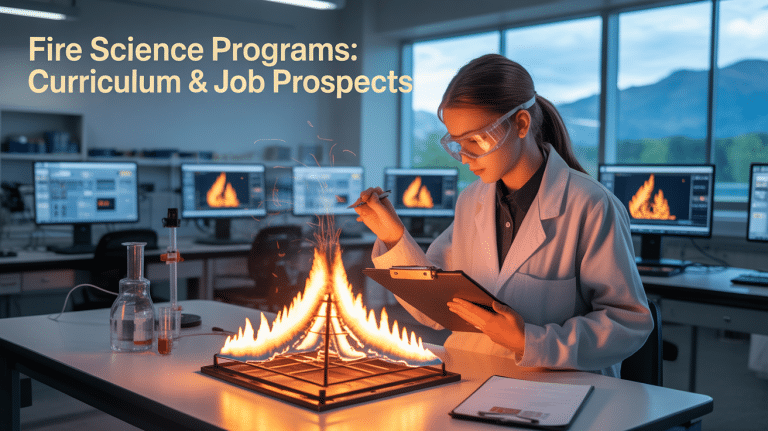
Fire Science Programs: Curriculum & Job Prospects
What is Fire Science? |
Core Curriculum Components |
Major Coursework |
Careers After Fire Science |
Salary Overview |
Is Fire Science Hard to Study? |
Top Certifications After Fire Science Graduation |
Where to Study Fire Science |
Overview of Fire Science Programs
Fire Science academic programs are meticulously crafted to prepare students for essential roles in fire service, emergency management, and related public safety fields. These programs integrate technical knowledge, practical skills, and foundational sciences to equip graduates for diverse careers as firefighters, fire officers, and safety specialists. Suitable for individuals who thrive in dynamic environments and are committed to community safety, this program provides a robust educational framework to meet both local and global challenges in public safety.
What is Fire Science?
Fire Science is an interdisciplinary field that focuses on the study of fire prevention, suppression, and safety management. It encompasses various subjects, including the chemical processes of fire, the engineering of fire protection systems, and the regulations related to fire codes and safety standards. The curriculum is designed to cultivate critical thinking, problem-solving skills, and a solid understanding of emergency response strategies.
Students typically engage in both theoretical and hands-on learning, preparing them to face real-world challenges in fire safety and emergency management. This academic program also emphasizes the importance of leadership, ethics, and effective communication in crisis situations.
What Do You Study in Fire Science?
Core Curriculum Components
Fire Science programs require a strong foundation in both general education and specialized fire science courses. Core subjects often include:
- English Composition
- Mathematics
- Social Sciences
- Arts and Humanities
Major Coursework
The specialized courses form the crux of the Fire Science curriculum and typically include:
- Introduction to Fire and Emergency Services: This course offers an overview of the historical context, structure, and responsibilities of the fire service.
- Fire Behavior and Combustion: A study of the chemical processes involved in combustion, heat transfer, and fire dynamics.
- Building Construction for Fire Protection: Examination of how structural design influences fire behavior and safety, essential for effective firefighting tactics.
- Fire Protection Systems: Analysis of fire detection, suppression, and alarm systems designed to protect life and property.
- Fire Prevention Practices: Focused on minimizing fire risks, this course covers inspection procedures, education initiatives, and code enforcement strategies.
- Fire Protection Hydraulics and Water Supply: Understanding the principles of hydraulics in delivering fire suppression agents efficiently.
- Strategy and Tactics: Learning to plan and execute fireground operations effectively for various emergency situations.
- Principles of Emergency Services: An overview of emergency response coordination and management; critical for teamwork in crises.
- Occupational Safety and Health for Emergency Services: Concentrating on regulatory compliance and risk reduction in emergency environments.
- Legal Aspects of Emergency Services: In-depth examination of laws and regulations governing fire service operations.
- Hazard and Disaster Management: Addresses both natural and anthropogenic hazards in community safety planning.
Additional Educational Experiences
Many Fire Science programs incorporate practical training scenarios, laboratory work, or internships with local fire departments to provide real-world experience in areas such as fire suppression, investigation, and leadership. These components are crucial for ensuring that students are job-ready upon graduation.
Careers After Fire Science
Fire Science graduates are equipped to pursue numerous career paths in public safety and emergency services, including:
- Firefighter: Engaging in front-line emergency response, providing services in municipal and industrial contexts.
- Fire Officer: Serving in supervisory roles such as fire lieutenant, captain, or chief, managing team operations and decision-making.
- Fire Inspector/Investigator: Assessing buildings for fire code compliance and investigating causes of fire, critical for legal and safety standards.
- Emergency Services Manager: Overseeing disaster response initiatives and preparedness planning for public and private sectors.
- Hazard Control Specialist: Working as an expert in implementing industrial and environmental fire prevention measures.
Sector Opportunities
Career opportunities can be found in various sectors, including:
- Municipal fire and emergency services
- Federal, state, and local government agencies
- Private industry focused on safety or risk management
- Insurance companies and fire protection equipment firms
Salary Overview
The average salary for Fire Science graduates varies based on position, location, and experience. Globally, salary ranges are as follows:
- Firefighter: Approximately $45,000 to $65,000 (USD) / €38,000 to €55,000 (EUR)
- Fire Officer: About $60,000 to $90,000 (USD) / €50,000 to €75,000 (EUR)
- Fire Inspector: Range of $50,000 to $80,000 (USD) / €42,000 to €67,000 (EUR)
- Emergency Services Manager: Estimated $70,000 to $115,000 (USD) / €60,000 to €97,000 (EUR)
Is Fire Science Hard to Study?
Studying Fire Science comes with its challenges. The field demands a strong understanding of scientific principles, particularly chemistry and physics, which can be complex for some students. Moreover, the practical aspects of fire behavior, safety regulations, and emergency management require students to develop critical, quick-thinking abilities in high-stress scenarios.
Common Challenges
- Understanding Scientific Concepts: Many students may find aspects of fire behavior and related chemical processes difficult to grasp.
- Physical Demands: Programs often include rigorous physical training components, especially for aspiring firefighters.
- High-Stress Situations: Students must be prepared to handle intense, life-or-death circumstances effectively.
Required Skills
- Strong analytical and problem-solving skills
- Effective communication abilities
- Leadership and teamwork aptitude
- Physical fitness and resilience in stressful environments
Preparation Tips
- Develop a solid foundation in mathematics and science before commencing your program.
- Engage in volunteer opportunities or internships that provide real-world experiences and enhance practical skills.
- Participate in fire drills or emergency response training courses to familiarize yourself with practical applications.
Top Certifications After Fire Science Graduation
After graduation, obtaining relevant certifications enhances a graduate’s employability and career advancement potential. Essential certifications may include:
- Emergency Medical Technician (EMT) License: Crucial for those wishing to work in emergency response roles.
- Firefighter I and II Certifications: Standard certifications for professional firefighters, encompassing fundamental firefighting techniques and safety.
- National Fire Protection Association (NFPA) Certifications: Standards recognized globally, covering a variety of fire prevention and response disciplines.
- Hazardous Materials Operations Certification: Important for responders managing hazardous incidents.
- Incident Command System (ICS) Certifications: Provides training on managing crises effectively within an established command framework.
Where to Study Fire Science
For those seeking to pursue a degree in Fire Science, several universities offer reputable programs that prepare students for the complexities of this field. Notable institutions include:
Each of these institutions provides a comprehensive curriculum, experienced faculty, and opportunities for practical training, making them excellent choices for aspiring fire science professionals.
Take the Next Step with Study in Turkiye
Explore further to find the right academic program that suits your needs and career aspirations in the field of Fire Science. Your journey in fire science and public safety starts here!

