
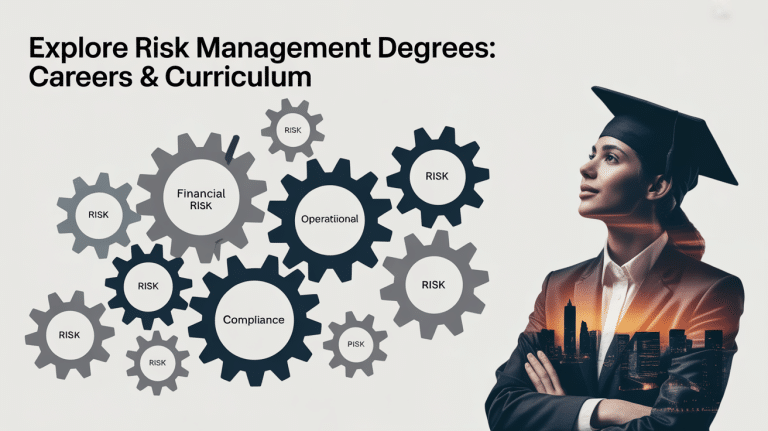
Overview of Risk Management Degrees
What is Risk Management?
Risk management is the discipline that focuses on identifying, assessing, and prioritizing risks followed by coordinated applications of resources to minimize, monitor, and control the probability or impact of unfortunate events. As businesses face increasing uncertainties due to economic fluctuations, regulatory changes, and technological advancements, the demand for risk management expertise continues to grow.
In a risk management degree program, students explore various risk domains, learn analytic methodologies, and develop decision-making frameworks critical for effective risk governance, aligning strategies with organizational goals.
What Do You Study in Risk Management?
The curriculum of a risk management program typically includes a blend of foundational business courses with specialized topics focused on risk. Below is a breakdown of core subjects and typical course offerings:
Core Subjects
- Risk Identification and Analysis: Students learn to detect potential risks, understand risk processes, and use analytical techniques to assess them.
- Risk Mitigation and Management Techniques: Emphasis on methods to prevent risks or minimize their impact on business operations.
- Financial Analysis and Accounting: Understanding financial systems is crucial for assessing risks related to investments and liabilities.
- Insurance Principles and Regulation Practices: Students gain knowledge of various insurance products and the legal frameworks that govern them.
- Legal and Regulatory Issues in Risk Management: Exploration of compliance and legal aspects related to risk.
- Data Analytics and Risk Modeling: This focuses on using data and technology to model and predict risks.
- Claims Management: Understanding how to handle claims processes effectively.
- Business Continuity Planning and Disaster Recovery: Strategies for maintaining business operations during disruptive events.
- Risk Control and Loss Prevention: Techniques used to manage risk factors and prevent financial losses.
- Ethics and Professionalism in Risk Management: Discusses the ethical implications of risk management decisions.
- Information Technology and Cybersecurity: Prepares students for risks related to information systems and data security.
Elective Courses
Some programs, such as those offered by universities like Penn State and St. John’s University, provide students with the opportunity to specialize in areas like:
- Enterprise Risk Management: Focuses on regulatory, legal, financial, and contractual risk exposures.
- Real Estate: Prepares students for careers in real estate management, brokerage, and appraisal.
Labs, Workshops, and Internships
Practical experience through internships and workshops is integral to risk management education. Students may engage in collaborative projects with industry professionals and participate in simulation exercises to apply their theoretical knowledge in real-world scenarios. Programs often encourage on-the-job training in risk-affected sectors such as finance, insurance, and corporate environments.
Careers After Risk Management
Graduates with a degree in risk management can pursue various career paths across both the private and public sectors. Here’s a breakdown of potential job titles, industries, and average salaries globally:
Common Job Titles
- Risk Analyst
- Risk Manager
- Insurance Underwriter
- Claims Adjuster
- Commercial, Property, and Liability Insurance Specialist
- Compliance Officer
- Financial Planner or Analyst
- Real Estate Manager or Broker
- Corporate Finance Specialist
- Government Compliance Roles
Average Salary Ranges
| Job Title | Average Salary (USD) | Average Salary (EUR) |
|---|---|---|
| Risk Analyst | $60,000 – $90,000 | €55,000 – €85,000 |
| Risk Manager | $80,000 – $120,000 | €70,000 – €110,000 |
| Insurance Underwriter | $50,000 – $80,000 | €45,000 – €75,000 |
| Claims Adjuster | $45,000 – $70,000 | €40,000 – €65,000 |
| Compliance Officer | $60,000 – $95,000 | €55,000 – €85,000 |
| Financial Planner | $65,000 – $110,000 | €60,000 – €100,000 |
| Real Estate Manager | $70,000 – $120,000 | €65,000 – €110,000 |
As demonstrated, risk management professionals are valued across industries, negotiating salaries significantly influenced by experience, geographic location, and sector.
Is Risk Management Hard to Study?
Studying risk management can be challenging due to the complexity of integrating various disciplines like finance, law, and data analysis. Students may encounter difficulties in:
- Quantitative Analysis: Many risk management courses involve complex mathematical and statistical analyses, requiring strong quantitative skills.
- Dynamic Regulatory Environments: Keeping up with constantly evolving laws and regulations can be demanding.
- Interdisciplinary Knowledge Requirements: A robust understanding across business, finance, and law is often essential.
Required Skills
To succeed in risk management, students should develop the following skills:
- Analytical and critical thinking
- Strong numerical and statistical abilities
- Excellent communication skills
- Problem-solving capabilities
- Attention to detail
- Familiarity with data analysis tools and software
Preparation Tips
- Focus on developing quantitative skills through coursework in statistics and finance.
- Participate in internships or workshops to gain practical experience and insights into the industry.
- Stay updated on the latest trends, regulations, and technologies affecting risk management.
Top Certifications After Risk Management Graduation
While a degree is foundational, obtaining relevant certifications can enhance credibility and job prospects in the risk management field. Here are some of the essential certifications:
- Certified Risk Manager (CRM): This certification boosts understanding of risk exposure and management techniques.
- Chartered Property Casualty Underwriter (CPCU): Focuses on property and liability insurance, beneficial for underwriters.
- Certified Information Systems Auditor (CISA): Essential for those interested in IT and cybersecurity risk.
- Project Management Professional (PMP): Valuable for roles involving project risk management.
- Financial Risk Manager (FRM): Offers specialized knowledge in financial risk management.
These certifications often require passing exams and meeting continuing education requirements.
Where to Study Risk Management
Here are some top universities that offer programs in risk management:
These institutions provide comprehensive curriculums and opportunities for personal and professional development in the field.
In conclusion, pursuing a degree in risk management prepares students for rewarding careers across various industries, offering the skills necessary to navigate complex, risk-filled environments. If you need personalized assistance in exploring academic programs in risk management, feel free to reach out to Study in Turkiye for expert guidance.
Take the Next Step with Study in Turkiye
Explore further and take your first step towards a rewarding career in risk management. Reach out today for more information about programs in Turkiye.

