
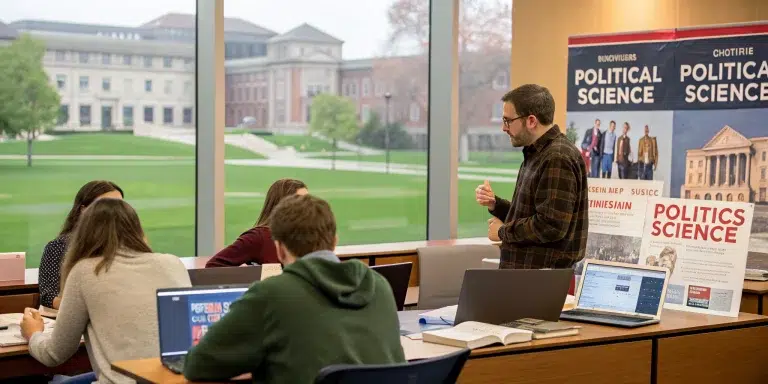
Political Science Degrees: Curriculum & Future Prospects
What is Political Science?
Political Science is the study of politics, government systems, and political behavior. It is an interdisciplinary field that draws from history, sociology, economics, and philosophy. Students engage in analysis, evaluation, and the practical application of political concepts on local, national, and international levels. This program is ideal for individuals interested in understanding how power structures operate, how policies are formulated, and how political decisions impact society.
The field encompasses several sub-disciplines, including:
- American Politics
- Comparative Politics
- International Relations
- Political Theory
What Do You Study in Political Science?
Core Areas of Study
Political Science degree programs typically require students to complete between 10-13 courses (approximately 39 credits) to fulfill major requirements. The curriculum is strategically designed to provide both breadth and depth of knowledge across the discipline’s primary subfields.
American Institutions and Politics
This area focuses on the U.S. political systems, institutions, and governance, allowing students to understand how legislation is formed and the roles of different branches of government.
Comparative Politics
Courses in this field examine political systems across different countries and regions, fostering analytical skills that enable students to compare and contrast various government structures and policies.
International Relations
This subfield studies interactions between nations, global governance, and foreign policy, giving students insights into international issues such as trade, conflict resolution, and diplomacy.
Political Philosophy/Theory
Students explore theoretical approaches to politics and governance, engaging with classical and contemporary political thought to understand the moral dimensions of political decision-making.
Course Breakdown
In a typical Political Science program, students may encounter the following types of courses:
- Introductory Courses: Such as Introduction to Political Science or American Government, these courses establish foundational knowledge essential for all majors.
- Research Methods: Courses in political analysis and research methodology are crucial, teaching students how to conduct research and critically assess political data.
- Core Subfield Requirements: Required courses in each major subfield ensure students gain comprehensive knowledge across American Politics, International Relations, and more.
- Upper-Level Electives: Typically at the 300-400 level, these specialized courses allow students to explore specific interests in greater depth.
- Senior Research/Capstone: Many programs conclude with a culminating research project or thesis, allowing students to engage in independent research and demonstrate their capabilities.
Practical Learning Opportunities
Many Political Science departments encourage students to enhance their education through:
- Experiential Learning: Internship programs, like the Washington Internship Semester, provide real-world experience in political settings.
- Study Abroad Programs: Opportunities to gain international educational experiences.
- Specialized Short Courses: 1.5 credit courses at the 200 level focusing on timely political issues.
Careers After Political Science
A degree in Political Science opens numerous paths across various sectors. Graduates can pursue a wide array of positions in:
- Government
- Law
- Nonprofit Organizations
- Education
- Business and Corporate Sectors
Sample Job Titles
- Policy Analyst
- Legislative Assistant
- Political Consultant
- International Relations Specialist
- Public Affairs Researcher
- Diplomat
Salary Ranges
Salaries for Political Science graduates can vary significantly based on position, experience, and location. Here are average salary ranges in the global market:
- Political Scientist: $70,000 – $120,000 (USD) / €60,000 – €100,000 (EUR)
- Legislative Assistant: $45,000 – $70,000 (USD) / €38,000 – €60,000 (EUR)
- Policy Analyst: $55,000 – $85,000 (USD) / €50,000 – €75,000 (EUR)
These salary expectations reflect the increasing demand for skilled professionals in political analysis and policy development.
Is Political Science Hard to Study?
Studying Political Science can present several challenges, including:
- Complex Theories and Concepts: Political theories can be sophisticated, requiring critical analytical skills.
- Understanding Diverse Perspectives: Students encounter a wide array of political ideologies and systems, which can be overwhelming.
- Research and Writing: Many courses emphasize rigorous research and writing, necessitating strong academic skills.
Required Skills
- Critical Thinking: Essential for analyzing complex political issues.
- Writing Proficiency: Crucial for articulating findings and positions.
- Communication Skills: Necessary for presenting arguments effectively.
Preparation Tips
- Stay Informed: Regularly engage with current events and political news.
- Develop Analytical Skills: Participate in debate clubs or discussion groups.
- Engage in Internships: Gaining real-world experience can enhance academic understanding.
Top Certifications After Political Science Graduation
While a degree in Political Science generally prepares graduates for immediate entry into the workforce, certain certifications can enhance job prospects:
- Public Policy Certificate: Useful for those seeking careers in policy analysis.
- Project Management Professional (PMP): Beneficial for roles in nonprofit management or government project oversight.
- Certified Government Financial Manager (CGFM): Relevant for careers in public finance.
Where to Study Political Science
For students interested in pursuing a degree in Political Science, the following universities offer renowned programs:
Each of these institutions provides a robust academic framework, experienced faculty, and a curriculum designed to impart the necessary knowledge to thrive in the field of Political Science.
Take the Next Step with Study in Turkiye
If you’re ready to explore your options in academia further, reach out to Study in Turkiye for personalized assistance in finding the right program for you.

