
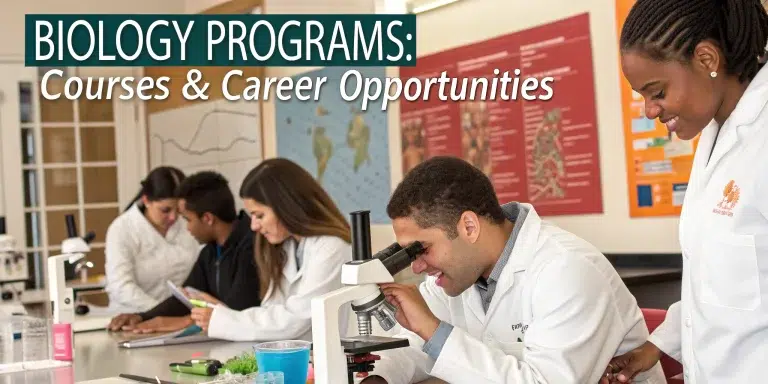
Biology Programs: Courses & Career Opportunities
What is Biology?
Biology is the scientific study of life and encompasses a range of topics, including cellular processes, genetics, evolution, and ecology. As a discipline, biology serves as the foundation for numerous scientific fields such as medicine, environmental science, biotechnology, and pharmacology. The significance of biology is evident in its applications, which include advancements in healthcare, conservation efforts, agriculture, and biotechnological innovations.
Students pursuing a degree in biology are typically driven by a desire to understand life on Earth, the complex interactions within ecosystems, and the underlying processes that govern biological organisms.
What Do You Study in Biology?
The curriculum for biology programs is structured to equip students with both theoretical knowledge and practical skills. Generally, students will explore core subjects and have the option to select elective courses to tailor their educational experience.
Foundational Courses
- Biology of Cells and Organisms: Introduction to cellular structure, function, and biological systems.
- Biology of Populations and Communities: Study of ecological relationships and population dynamics.
- Genetics: Exploration of heredity, genetic variation, and molecular genetics.
- Cell Biology: In-depth study of cellular structure, function, and processes.
- Evolution and Ecology: Understanding of the mechanisms of evolution and ecological principles.
Advanced Coursework
- Molecular Cell Biology: Focus on the molecular mechanisms governing cellular processes.
- Experimental Design: Methods for designing biological experiments and analyzing data.
- Genetics and Laboratory: Practical applications of genetic principles in a laboratory setting.
- Ecology and Field Biology: Study of ecological principles in natural environments.
Laboratory Experience
Practical laboratory work is integral to biology programs. Students typically select from various laboratory courses that may include:
- Comparative Vertebrate Anatomy: Study of vertebrate anatomy and organ systems.
- Genetics Laboratory: Practical application of genetics concepts and techniques.
- Molecular Biology Laboratory: Hands-on experience with molecular biology techniques.
- General Ecology Laboratory: Exploration of ecological concepts through fieldwork.
Careers After Biology
A degree in biology opens doors to diverse career paths. Graduates may pursue various job titles and opportunities across multiple industries:
- Biological Technician
- Microbiologist
- Bioinformatics Specialist
- Genetic Counselor
- Ecologist
- Pharmaceutical Sales Representative
- Research Scientist
- Environmental Consultant
- Healthcare Professional
Average Salaries
The earning potential for biology graduates can vary significantly based on job title, experience, and location. As of recent data, here are some average salary ranges globally:
- Biological Technician: $45,000 – $60,000 (40,000 – 55,000 EUR)
- Microbiologist: $50,000 – $90,000 (46,000 – 82,000 EUR)
- Biotechnology Scientist: $70,000 – $120,000 (64,000 – 110,000 EUR)
- Research Scientist: $60,000 – $100,000 (55,000 – 91,000 EUR)
- Genetic Counselor: $75,000 – $100,000 (68,000 – 91,000 EUR)
Preparation Tips
To aid your success in biology, consider the following preparation tips:
- Engage with Study Groups: Collaborate with peers to enhance understanding of complex topics.
- Utilize Resources: Take advantage of textbooks, online courses, and other educational resources.
- Seek Help Early: Don’t hesitate to ask instructors for clarification on challenging concepts.
Where to Study Biology
Students interested in pursuing a biology degree have several prestigious private universities to consider, including:
These institutions provide comprehensive programs that equip students with the necessary knowledge and skills to succeed in biological sciences.
Take the Next Step with Study in Turkiye
For personalized assistance in navigating your academic path, consider reaching out to Study in Turkiye today and explore the numerous opportunities available in the field of biology.

