
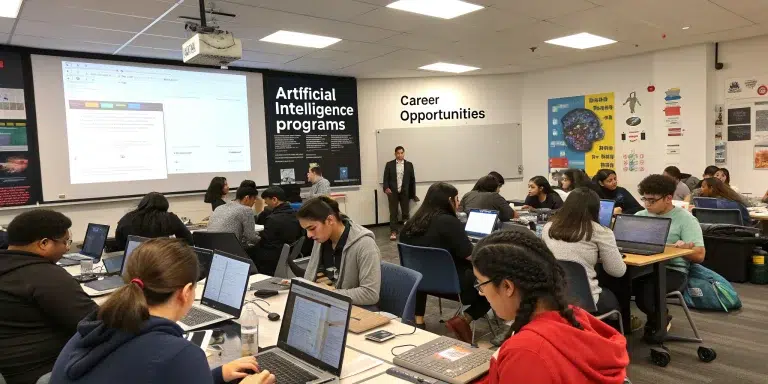
Artificial Intelligence Programs: Curriculum & Career Opportunities
What is Artificial Intelligence?
Artificial Intelligence encompasses a broad field of computer science focused on creating systems that can perform tasks that typically require human intelligence. This includes reasoning, learning, adapting, and problem-solving. AI leverages a combination of advanced algorithms, data structures, and innovative technologies to create machines capable of understanding and responding to their environment in intelligent ways.
The scope of AI ranges from developing algorithms that can optimize processes to constructing autonomous systems capable of making decisions. This complex field draws from various disciplines, including mathematics, cognitive science, and engineering, contributing to its rapid evolution and expanding applications across various sectors.
What Do You Study in Artificial Intelligence?
Students enrolled in AI programs will explore a variety of core subjects designed to build a strong foundation in both theoretical concepts and practical skills required in the field. The curriculum is typically structured as follows:
Core Subjects
- Mathematical Foundations:
- Discrete Mathematics
- Probability and Statistics
- Optimization
- Logic
- Fundamentals of Computer Science:
- Data Structures
- Programming
- Algorithm Design
- Computing Systems
AI Techniques
- Machine Learning:
- Supervised Learning
- Unsupervised Learning
- Reinforcement Learning
- Symbolic Computation and Knowledge Representation
- Problem-Solving and Heuristic Programming
- Pattern Recognition and Perception
Specialized Topics
- Computer Vision
- Natural Language Processing (NLP)
- Robotics and Autonomous Agents
- Cognitive Robotics
Sample Curriculum Highlights
| Course Example | Description |
|---|---|
| Artificial Intelligence Representation | Techniques for structuring and solving problems in AI. |
| Introduction to Machine Learning | Core principles and practices in the machine learning field. |
| Computer Vision | Methods for analyzing visual information. |
| Natural Language Processing | Techniques for processing and understanding languages. |
| Neural Computation | Understanding neural networks and complex learning systems. |
| Autonomous Agents | Creating systems that can operate and solve problems independently. |
| Planning Techniques for Robotics | Algorithms for robotic action planning and control. |
| Cognitive Robotics | Engineering adaptive robots capable of intelligent behavior. |
Careers After Artificial Intelligence
The demand for AI professionals is growing rapidly across numerous industries, leading to diverse career opportunities for graduates. Job prospects include, but are not limited to:
- AI/Machine Learning Engineer
- Data Scientist or Analyst
- Robotics Engineer
- Software Developer (with a focus on intelligent systems)
- Research Scientist (specializing in AI, robotics, computer vision, or NLP)
- Cognitive Computing Specialist
Industries Employing AI Graduates
AI graduates can find opportunities in:
- Technology Companies: Working in software development, AI solutions, and product innovation.
- Research Labs & Academia: Engaging in groundbreaking AI research and technological advancements.
- Healthcare: Utilizing AI for diagnostics, patient management, and healthcare data analysis.
- Finance: Developing algorithms for trading, risk management, and fraud detection.
- Manufacturing: Implementing AI in automation and production optimization.
- Public Sector: Contributing to policies and ethical guidelines regarding AI deployment.
Average Salaries
Salaries in the field of Artificial Intelligence can vary based on position, experience, and geographical location. Here are estimated annual salary ranges:
- AI/Machine Learning Engineer: $95,000 – $150,000 / €80,000 – €130,000
- Data Scientist: $85,000 – $135,000 / €70,000 – €115,000
- Robotics Engineer: $78,000 – $120,000 / €65,000 – €100,000
- Software Developer: $80,000 – $130,000 / €68,000 – €110,000
- Research Scientist: $100,000 – $160,000 / €85,000 – €135,000
Top Certifications After Artificial Intelligence Graduation
After completing an AI program, obtaining relevant certifications can enhance career prospects. Some valuable certifications include:
- Certified Artificial Intelligence Practitioner (CAIP)
- TensorFlow Developer Certificate
- AWS Certified Machine Learning – Specialty
- Microsoft Certified: Azure AI Engineer Associate
These certifications can help graduates demonstrate their expertise and differentiate themselves in the competitive job market.
Where to Study Artificial Intelligence
Students considering a career in Artificial Intelligence have numerous options at esteemed institutions. Some leading universities include:
These institutions offer comprehensive programs designed to equip students with the requisite knowledge and skills for a successful career in AI.
Conclusion
Artificial Intelligence academic programs provide a robust curriculum that prepares students for the evolving demands of one of the most dynamic and impactful fields today. By understanding the foundational knowledge, specialized techniques, and career pathways available within AI, aspiring students can position themselves for meaningful and lucrative careers. For personalized guidance in exploring and applying to AI programs, reach out to Study in Turkiye for assistance in your educational journey.
Take the Next Step with Study in Turkiye
Explore further opportunities to enrich your education and prepare for a career in Artificial Intelligence.

