
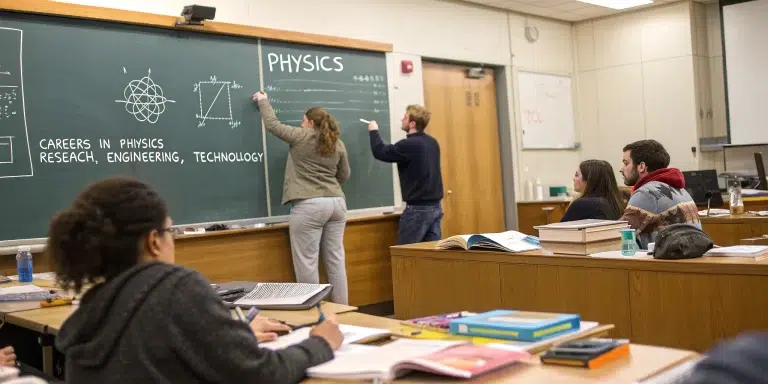
Physics Degrees: Curriculum, Careers & More
What is a Physics Degree Program?
A physics degree program is designed to equip students with comprehensive knowledge in classical and modern physics. Most programs culminate in either a Bachelor of Science (B.S.) or Bachelor of Arts (B.A.). The B.S. program tends to emphasize mathematics and scientific topics in greater depth, while the B.A. may offer a broader approach with fewer core requirements in mathematics.
Degree Variants
- Bachelor of Science (B.S.) in Physics: Usually includes extensive coursework in core areas such as mechanics, electromagnetism, quantum mechanics, and thermodynamics/statistical mechanics. This path often features various laboratory courses and opportunities for faculty-guided research.
- Bachelor of Arts (B.A.) in Physics: Often has fewer required advanced courses in mathematics and physics, enabling students to explore a wider liberal arts study or pursue double majors alongside physics.
What Do You Study in Physics Degree Programs?
Core Areas of Study
- Classical Mechanics: Examines the motion of objects and the forces acting upon them, from fundamental particles to astronomical bodies.
- Electromagnetism: Focuses on electric and magnetic fields and their interactions, forming a core part of modern physical theories.
- Quantum Mechanics: Explores the principles governing microscopic systems, providing insights into phenomena like atomic structure and subatomic particle behavior.
- Thermodynamics/Statistical Mechanics: Investigates the macroscopic properties of matter and energy transfer, essential for understanding physical systems’ thermal behaviors.
- Mathematics: Students will undertake courses in calculus, linear algebra, differential equations, and sometimes computational methods, which are vital for modeling physical systems.
Laboratory and Research Components
Physics majors engage in laboratory work from early semesters. They start with general physics labs and evolve into advanced labs focused on research that utilizes cutting-edge equipment and methods akin to those employed in faculty-led projects. Research opportunities, both theoretical and experimental, embody critical aspects of physics programs and prepare students for graduate studies or professional endeavors.
Degree Tracks and Specializations
Some institutions may allow students to choose specialized tracks such as:
- Astrophysics
- Existential and Philosophical Aspects of Physics
- Computational Science
- Materials Science
- Physics Education
Sample Four-Year Progression
A typical progression in a physics program may look as follows:
- Year 1: Calculus, introductory general physics with labs
- Year 2: Differential equations, classical mechanics, modern physics
- Year 3: Quantum mechanics, statistical mechanics/thermodynamics, advanced electromagnetism, research labs
- Year 4: Advanced electives, specialized labs, and potentially an independent research project or thesis.
Careers After Physics Degree
Graduates with a physics degree possess a versatile skill set that opens doors to diverse careers across industries. Some common career trajectories include:
- Professional Physicist: Engaging in research or technical roles in various sectors, including academia, government, and private industry.
- Graduate Studies: Pursuing M.S. or Ph.D. programs in physics or related fields.
- Engineering Positions: Focusing on areas like materials science and nano-engineering.
- Data Science: Utilizing computational expertise for data analysis and model simulations.
- Teaching: Opportunities range from middle and high school teaching to collegiate instruction, particularly for those with an educational specialty.
- Fields of Science: Expanding into careers related to chemistry, environmental science, oceanography, engineering physics, and biochemistry.
Salary Ranges
Salaries for physics graduates vary widely based on the role and location. Here are some average annual salary estimates:
- Professional Physicist: $80,000 USD / €75,000 EUR
- Data Scientist: $96,000 USD / €90,000 EUR
- Research Scientist: $85,000 USD / €80,000 EUR
- University Professor: $70,000 USD / €65,000 EUR
Is Physics Hard to Study?
Physics is often perceived as a challenging discipline due to its abstract concepts and extensive mathematical applications. Common difficulties students face include:
- Mathematics Proficiency: A strong foundation in mathematics is essential, particularly in calculus and differential equations.
- Abstract Thinking: Physics requires the ability to conceptualize complex phenomena often outside ordinary experience.
- Problem-solving Skills: Success in physics hinges on effectively solving challenging technical problems.
Preparation Tips
- Build a solid grounding in mathematics before entering the program.
- Develop critical thinking and problem-solving skills through practice and coursework.
- Engage with physics materials outside the classroom, such as textbooks, online resources, and experimental projects.
Top Certifications After Physics Degree Graduation
Upon graduation, certain certifications and licenses may enhance career prospects. While physics itself does not require formal licensure, the following certifications can be beneficial:
- Certified Physics Teacher (for those pursuing education)
- Graduate Record Examination (GRE) (for those seeking graduate studies)
- Physics Olympiad or other recognized competitions (demonstrating proficiency)
- Professional Engineering License (if entering engineering fields)
Where to Study Physics
Several private universities offer excellent programs in physics. Here are a few noteworthy institutions:
Consider exploring these universities to find the right program and make informed decisions about your education.
Take the Next Step with Study in Turkiye
If you’re intrigued by the possibilities that a physics degree can unlock for your future, reach out to Study in Turkiye for personalized assistance in finding the perfect academic program tailored to your needs.

