
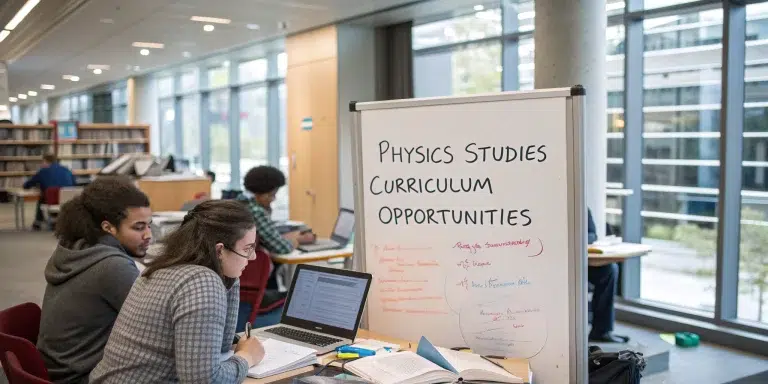
Physics Studies: Curriculum & Future Careers
What is Physics?
What Do You Study in Physics?
Learning Methods
Careers After Physics
Is Physics Hard to Study?
Top Certifications After Physics Graduation
Where to Study Physics
Overview of the Academic Program
Physics studies delve into the exploration of the natural universe, examining everything from the dynamics of stars to the behaviors of subatomic particles. This academic program is tailored for individuals who have a robust curiosity about the laws that govern the physical world and a passion for applying these principles to solve real-world problems. Through a combination of theoretical instruction and extensive practical experimentation, students gain both foundational and advanced knowledge essential for a variety of fields.
What is Physics?
Physics is often described as the fundamental science, providing the groundwork for various disciplines including chemistry, engineering, astronomy, and even biology. The science explores concepts such as energy, force, mass, and charge, with branches that include classical mechanics, thermodynamics, electromagnetism, and quantum mechanics.
An academic program in physics equips students with analytical skills, critical thinking, and problem-solving abilities, enabling them to both comprehend and manipulate the physical principles that shape our universe.
What Do You Study in Physics?
Core Subjects and Sequence
- Classical Mechanics: Students learn about motion, forces, energy, and momentum, forming the basis for understanding more complicated systems.
- Modern Physics: An introduction to concepts such as relativity and quantum theory, including atomic and nuclear physics.
- Thermal Physics: This course covers the laws of thermodynamics, heat transfer, and kinetic theory, allowing students to understand energy transfer.
- Electricity and Magnetism: Fundamentals of electrostatics, electric circuits, electromagnetic fields, and waves are explored in depth.
- Quantum Mechanics: This branch dives into the quantum behavior of matter and energy, challenging classical notions of physics.
- Experimental Physics: A hands-on approach to learning, students engage in laboratory investigations to emphasize measurement, data analysis, and the scientific method.
- Mathematics for Physics: This encompasses calculus, differential equations, matrix algebra, and computational methods.
Advanced and Elective Topics
- Astrophysics: The study of celestial bodies and the universe beyond Earth’s atmosphere.
- Biophysics: An interdisciplinary field that applies the principles of physics to biological systems.
- Condensed Matter Physics: Exploration of the physical properties of condensed phases of matter.
- Computational Physics: Utilizing computer simulations to solve complex physical systems and problems.
Learning Methods
- Textbook Instruction: Physics programs frequently utilize textbooks that convey complex ideas in a conversational and illustrative manner to foster conceptual understanding.
- Laboratory Experiments: Practical experimentation is fundamental in physics education, often conducted in well-equipped labs where students apply theoretical knowledge.
- Capstone Projects: In their final year, students may engage in research projects or seminars to integrate and apply what they have learned throughout their studies.
- Audiobooks and Alternative Learning Tools: Some academic programs offer material in diverse formats, enabling accessibility for auditory learners.
Careers After Physics
A degree in physics paves the way for numerous prestigious positions in various industries. Graduates can pursue careers in sectors including technology, research, education, and engineering. Below are potential career paths, relevant job titles, and average salary statistics:
Job Titles
- Research Scientist
- Physicist in government or private sectors
- Aerospace Engineer
- Materials Scientist
- Data Analyst
- Computational Physicist
- Physics Educator
- Technical Consultant
Salary Ranges (averaged based on global data)
- United States: $60,000 – $120,000 (approx. 55,000 – 110,000 EUR)
- Europe: €40,000 – €90,000 (approx. $45,000 – $100,000 USD)
The field of physics is projected to grow, with emerging technologies and a heightened focus on energy and environmental issues driving demand for physicists and related professionals.
Is Physics Hard to Study?
Studying physics can be challenging due to its conceptual complexity and mathematical rigor. Here are common challenges, required skills, and preparation tips for prospective students:
Common Challenges
- Understanding abstract concepts, particularly in quantum mechanics and advanced mathematics.
- Mastery of mathematical tools and problem-solving techniques.
- Application of theory to practical experiments, requiring analytical skills in evaluating results.
Required Skills
- Strong mathematical abilities.
- Analytical thinking and critical reasoning skills.
- Proficiency in scientific research methods.
- A passion for inquiry and exploration in the natural sciences.
Preparation Tips
- Engage with high school-level physics and mathematics to build a solid foundation.
- Utilize online resources, tutorials, and practice problems to enhance understanding.
- Collaborate with peers for group studies and discussions to broaden perspective and knowledge.
Top Certifications After Physics Graduation
Upon graduation, physics students may consider acquiring additional certifications or licenses to enhance their employability. Some essential post-graduation credentials include:
- Certified Physics Teacher (CPT): This certification is important for those pursuing teaching careers in secondary education.
- Professional Engineer (PE): Relevant for those who venture into engineering, this certification is advantageous and sometimes required for practicing engineers.
- Data Science Certifications: For graduates aiming to enter the tech field, certifications in data analysis or computational tools can be beneficial.
Where to Study Physics
Students interested in pursuing a physics degree have several top private universities to choose from. Below are some recommended institutions:
- Bahcesehir University (BAU) – Istanbul
- Istanbul Medipol University – Ankara
- Uskudar University
- Ozyegin University
These institutions offer robust physics programs, experienced faculty, and a range of resources to support student success.
Take the Next Step with Study in Turkiye
If you’re considering a career in physics or need personalized assistance, reach out to Study in Turkiye for tailored guidance and information about academic programs that align with your goals. Your academic journey starts here!

